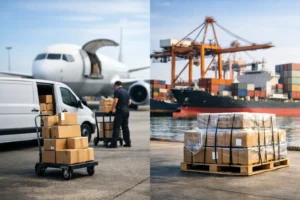
When a production line is waiting on components or a customer order has a fixed delivery window, air freight becomes a business decision, not a convenience. It is the shipping mode companies use when speed, control, and schedule reliability matter more than the lowest possible freight cost.
For SMEs, manufacturers, distributors, and trading companies, air freight plays a specific role in the supply chain. It supports urgent replenishment, high-value goods, launch-sensitive inventory, and shipments that cannot afford extended transit times. Used well, it protects revenue, reduces operational disruption, and gives businesses more flexibility across international markets.
What air freight is really for
Air freight is designed for cargo that needs to move internationally within tight timelines. Compared with ocean shipping, it cuts transit time significantly and offers more predictable flight schedules across major trade lanes. That speed is why many businesses rely on it for critical stock movements, samples, electronics, medical items, automotive parts, fashion goods, and other products where delay carries a real cost.
That does not mean air freight is the right answer for every shipment. It is usually more expensive than sea cargo, and cargo dimensions, weight, and airline capacity can affect feasibility. The value of air freight is strongest when the shipment’s urgency, product value, or downstream business impact justifies the premium.
Why businesses choose air freight
The most obvious reason is speed, but speed alone is not the full picture. Businesses choose air freight because it helps them maintain continuity. A delayed sea shipment might create stockouts, missed production deadlines, retail penalties, or unhappy customers. Air freight is often the practical response when the cost of delay is higher than the cost of transport.
It also supports better inventory strategy. Some companies use air freight selectively to keep leaner stock levels and replenish faster, rather than tying up working capital in large inventory buffers. Others use it for product launches, promotional windows, or seasonal demand where timing is fixed and late delivery weakens the sales opportunity.
There is also the matter of shipment handling. In many cases, air cargo moves through a more controlled transit cycle with shorter dwell times. For sensitive or high-value products, that can reduce exposure compared with longer, multi-stage shipping routes.
When air freight makes commercial sense
The strongest use case for air freight is urgency with clear business consequences. If a missing component can stop production, the freight cost is often minor compared with downtime. If an importer needs to fulfill a contractual delivery date, fast transport may protect both revenue and customer relationships.
High-value and low-volume goods are also well suited to this mode. Products such as electronics, aerospace parts, branded consumer goods, and specialized industrial items often carry enough value per kilogram to justify air transport. The same applies to time-sensitive samples, replacement parts, and launch inventory.
There are also cases where businesses use a mixed-mode strategy. A company may ship core volume by sea to manage cost, then move urgent shortfalls by air. This is often the most balanced approach because it protects budgets while preserving supply chain responsiveness.
What affects air freight cost
Air freight pricing is shaped by more than distance. Chargeable weight is one of the main factors, which means pricing may be based on actual weight or volumetric weight, depending on which is higher. Lightweight cargo with large dimensions can therefore cost more than expected.
Capacity conditions also matter. Rates can move with seasonal demand, major holidays, route imbalances, and broader disruptions in the market. A shipment moving during peak periods may face both higher pricing and tighter space availability.
Service scope is another factor. Airport-to-airport transport is only one part of the total cost. Businesses also need to consider pickup, export handling, customs processing, documentation, destination clearance, last-mile delivery, and any special handling requirements. The real commercial question is not just the flight cost, but the full door-to-door logistics cost and the business outcome it supports.
Air freight and customs coordination
Fast transit only delivers value when customs and documentation are handled correctly. A shipment can leave quickly and still lose time if paperwork is incomplete, commodity details are inaccurate, or import requirements are missed at destination.
That is why execution matters as much as transport mode. Commercial invoices, packing lists, permits, declarations, and commodity classifications all need to be aligned before cargo moves. For businesses shipping internationally on a regular basis, a freight partner that understands route requirements and customs coordination can prevent delays that erase the speed advantage of air transport.
This is especially relevant for companies shipping across multiple markets. Different destinations can have different inspection standards, import restrictions, and documentation rules. Air freight works best when the operational side is organized from the start.
Choosing between air freight, express, and sea cargo
Many business shippers compare air freight with express courier and sea cargo because all three can support international delivery, but they serve different needs.
Air freight is generally the better fit for commercial cargo that is urgent but too large, too heavy, or too operationally complex for standard parcel networks. It offers faster transit than sea cargo and more flexibility for B2B shipment planning than small-parcel express services.
Express shipping is often best for documents, parcels, samples, and smaller high-priority shipments with simplified handling. Sea cargo remains the cost-efficient option for larger-volume freight where transit time is less critical. The right choice depends on shipment size, urgency, product value, and the commercial impact of delay.
For many businesses, the best logistics setup is not choosing one mode exclusively. It is having access to the right mix, so shipping decisions can change based on urgency, budget, and customer demand.
How to use air freight more effectively
Companies get the best results from air freight when they use it strategically rather than reactively. That starts with planning around real business priorities. Not every urgent request is equally urgent, and not every late order should automatically move by air. The question is whether faster shipping protects revenue, avoids loss, or supports a critical customer commitment.
Forecasting also helps. If recurring products frequently need urgent replenishment, the issue may be inventory planning rather than transport mode. Air freight can solve immediate gaps, but repeated emergency shipments usually signal a broader supply chain problem.
Packaging and cargo readiness are also important. Well-prepared shipments move faster through handling points and reduce the risk of dimensional surprises, documentation mismatches, or loading issues. Businesses that standardize packing data, product descriptions, and export documents usually experience fewer delays.
What to look for in an air freight partner
For business shipments, the provider matters as much as the route. A dependable air freight partner should offer more than booking space on a flight. The real value is coordination across pickup, documentation, export handling, customs processes, transit planning, and final delivery.
Reliability is the first requirement. Businesses need realistic transit expectations, clear communication, and active shipment management when schedules change. Visibility also matters. Operations teams and procurement leads need to know where cargo stands and whether any action is required.
Global reach should be backed by execution, not broad claims. That means proven handling across international trade lanes, support for different shipment types, and the ability to align air freight with sea cargo or express services when the situation calls for it. For companies shipping from Malaysia into global markets, this flexibility is especially useful because freight priorities can shift quickly between cost control and delivery speed. Providers such as Cargovia are positioned around that model, giving businesses access to premium freight coordination across multiple transport modes.
The trade-off businesses should keep in view
Air freight is fast, but it should still be treated as a targeted tool. Used for the right shipments, it protects supply chains and helps businesses stay responsive. Used without discipline, it can push logistics costs higher than necessary.
That is why the best shipping decisions usually come down to context. How urgent is the shipment really? What is the cost of delay? Is this a one-time exception or a recurring planning gap? Those questions matter more than choosing the fastest option by default.
For businesses moving goods internationally, air freight remains one of the most effective ways to keep cargo moving when timing cannot slip. The real advantage is not simply speed. It is the ability to act quickly, protect commitments, and keep operations on track when the margin for delay is gone.
When deadlines are fixed and the shipment matters, the strongest logistics decision is often the one that keeps your business moving without added uncertainty.