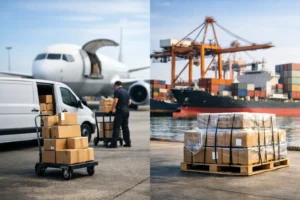
A delayed shipment rarely stays a shipping problem for long. It turns into a production gap, a missed retail window, a stockout, or a customer escalation. That is why global shipping solutions matter to businesses that import, export, distribute, or fulfill across borders. The right freight setup does more than move cargo – it protects timelines, margins, and customer commitments.
For business shippers, the real challenge is not simply finding transport. It is choosing a shipping model that fits the product, deadline, budget, and destination while keeping operations controlled from origin to delivery. That is where a capable logistics partner adds value. Good execution reduces uncertainty. Better execution gives your team room to plan ahead.
What global shipping solutions actually cover
Global shipping solutions are not a single service. They are a coordinated set of transport, documentation, routing, and shipment management capabilities that help businesses move goods internationally with fewer disruptions.
In practical terms, that usually means access to air freight for urgent cargo, sea freight for larger-volume or cost-sensitive shipments, and express delivery for smaller parcels or time-critical commercial documents. It also includes customs coordination, transit planning, freight scheduling, and shipment visibility.
For SMEs and corporate shippers, the benefit is straightforward. Instead of managing separate vendors for every mode and every destination, you work with one logistics partner that can align the movement based on business priorities. That matters when demand changes quickly, suppliers shift timelines, or customers ask for faster delivery than expected.
Why one-size-fits-all shipping rarely works
Many shipping issues start with a mismatch between the freight mode and the shipment itself. A high-value product with a tight launch date should not be treated the same way as replenishment stock with flexible lead time. Yet companies often default to the same booking habits until delays or costs force a review.
Air freight is faster, but it carries a higher rate. Sea cargo is more economical for larger loads, but transit times are longer and port schedules can be less forgiving. Express shipping offers speed and convenience for smaller consignments, though it is not the right fit for every shipment profile.
The right answer depends on what your business is trying to protect. Sometimes speed is the priority because a missed deadline affects revenue. Sometimes cost control matters more because the cargo is part of a recurring supply plan. In many cases, the best result comes from using multiple modes instead of relying on one.
Choosing between air, sea, and express
Air freight for urgency and control
Air freight is typically the best option when time has direct commercial value. That includes product launches, urgent replenishment, spare parts, seasonal goods, and high-value cargo where shorter transit reduces exposure.
It also gives businesses better flexibility when production schedules move late. If a supplier loses several days, air freight can recover part of that time. The trade-off is cost. Businesses should use air freight where the value of speed clearly outweighs the premium.
Sea cargo for volume and cost efficiency
Sea cargo remains essential for businesses moving larger quantities, heavier goods, or non-urgent inventory. It supports better landed-cost control and is often the most practical choice for regular import-export cycles.
The trade-off is planning discipline. Sea freight works best when procurement, inventory, and sales teams are aligned on lead times. If forecasting is weak or stock buffers are too thin, lower freight cost can be offset by disruption elsewhere.
Express shipping for smaller critical movements
Express services are useful when the shipment is smaller but still time-sensitive. Samples, replacement items, urgent B2B parcels, and critical documents often fit this category.
For many businesses, express shipping fills the gap between courier convenience and larger freight operations. It is not a replacement for broader freight planning, but it can solve immediate problems fast when timing is non-negotiable.
What businesses should expect from global shipping solutions
Reliable shipping is not defined by a quoted transit time alone. Businesses need consistency in booking, communication, and execution. A service that looks competitive on paper can still create internal costs if updates are slow, handoffs are unclear, or exceptions are handled poorly.
Strong global shipping solutions should give your team confidence in five areas. First, mode flexibility, so shipments can move by air, sea, or express depending on need. Second, operational coordination, so cargo movement does not break down between origin handling, customs, and final delivery stages. Third, visibility, because procurement and operations teams need updates they can act on. Fourth, commercial clarity, with service recommendations that reflect business priorities rather than generic routing. Fifth, consistency, especially for companies shipping regularly across established trade lanes.
This is where premium service has practical value. It is not about presentation. It is about reducing avoidable friction in international movement and giving businesses a more dependable operating rhythm.
Common problems a freight partner should help solve
International shipping usually becomes difficult in familiar ways. Booking windows close. Supplier handovers slip. Customs paperwork is incomplete. A shipment moves, but nobody has a clear update. These are not unusual events. The issue is whether your logistics partner can respond quickly and keep the movement on track.
A good freight provider should help reduce recurring pain points such as delayed deliveries, fragmented communication, and poor mode selection. Businesses should not have to chase multiple parties for basic shipment status or guess whether a delay at origin will affect final delivery.
When a provider understands commercial freight, the conversation improves. Instead of only quoting rates, they help weigh urgency against cost, review routing options, and flag risks before they disrupt a supply chain. That is especially useful for SMEs that need enterprise-level shipping support without building a large in-house logistics team.
How to evaluate a provider of global shipping solutions
Choosing a logistics partner should be based on operating fit, not just price. A low rate can look attractive until service inconsistency creates inventory pressure or damages customer commitments.
Start with mode coverage. If your business may need air freight one month and sea cargo the next, your provider should support both without making the transition difficult. Then assess communication. Fast, accurate updates matter more than broad promises. Ask how shipment milestones are managed, how exceptions are escalated, and how your team will be kept informed.
Next, look at experience with business shipping needs similar to yours. A company moving manufacturing inputs has different priorities from an e-commerce seller or a distributor managing regular replenishment. The provider should understand those differences and recommend service accordingly.
Finally, consider whether the provider can scale with your business. International shipping requirements tend to become more complex over time. New markets, larger volumes, tighter delivery windows, and mixed shipment profiles all place more pressure on coordination. A capable partner should support that growth without forcing you to rebuild your shipping process every few months.
Why Malaysia-based businesses need flexible freight planning
For companies shipping from Malaysia to global markets, flexibility is especially important. Export schedules, regional sourcing patterns, and customer expectations can shift quickly. Some shipments demand speed to protect sales or production continuity. Others need cost discipline to support margin targets on recurring trade.
That is why many businesses benefit from working with a provider that can manage multiple freight modes under one service structure. Cargovia supports this model by offering premium air freight, sea cargo, and express shipment services for companies that need dependable cross-border execution from Malaysia. For business clients, that means less fragmentation and a more practical way to align shipping decisions with real operating needs.
Global shipping solutions as a business decision
Shipping should not be treated as an isolated back-end function. It affects procurement timing, inventory exposure, customer service performance, and cash flow. When freight planning is weak, other departments absorb the consequences. When it is managed well, operations become more stable and easier to scale.
That is why the best global shipping solutions are built around business outcomes, not just transport. They help companies decide when to move faster, when to consolidate, when to control cost, and when to prioritize certainty over rate. The right freight approach will not remove every disruption, but it will give your business a stronger response when conditions change.
If your shipments are growing in volume, value, or urgency, it may be time to review whether your current freight setup is supporting the business you are running now, not the one you were running a year ago.