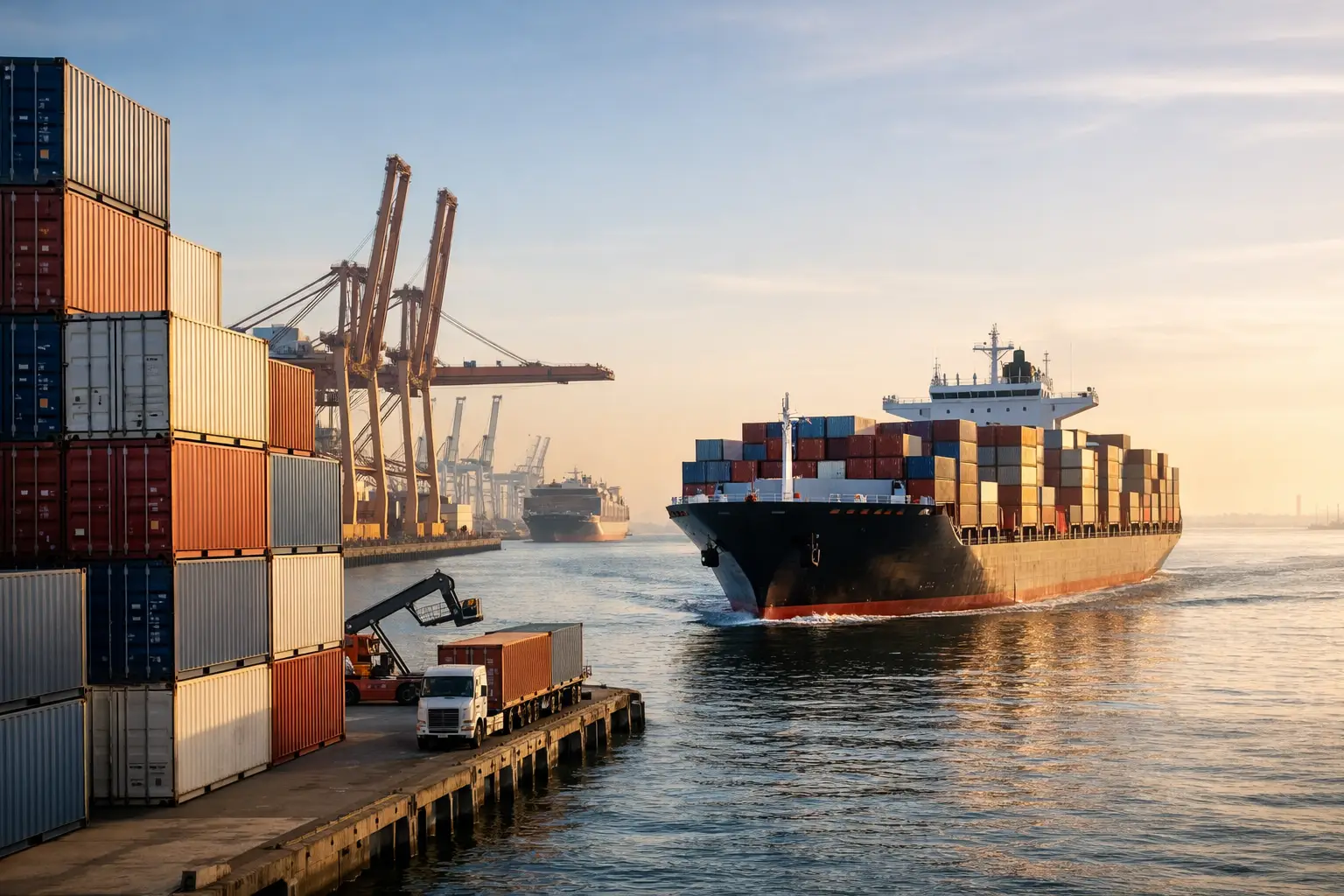
When a shipment is too large for courier networks and too cost-sensitive for air cargo, sea freight becomes the practical business decision. For importers, exporters, manufacturers, and distributors, it is often the mode that keeps inventory moving at a workable landed cost while supporting steady international trade.
Why sea freight still matters
Sea freight remains the backbone of global commerce because it handles volume efficiently. Businesses shipping raw materials, retail goods, machinery, components, or finished products often need a mode that can absorb larger loads without making transport costs unmanageable. That matters even more when margins are tight or replenishment cycles depend on predictable freight planning.
The main advantage is cost efficiency per unit, especially for heavier or bulkier cargo. Air freight may reduce transit time, but the price difference can be substantial. Sea cargo gives businesses room to ship larger quantities in a single movement, which can improve purchase economics, reduce the number of shipments required, and support more stable supply chain planning.
That said, lower cost does not mean simpler execution. Ocean shipping involves routing decisions, documentation, port handling, customs coordination, container management, and delivery scheduling at destination. The real value comes from using sea freight in a way that matches the product, timeline, and commercial objective.
When sea freight is the right choice
Sea freight works best when shipment urgency is moderate to low and cargo volume is meaningful enough to benefit from containerized transport. Many businesses use it for scheduled replenishment rather than emergency stock recovery. If production lead times are known and demand planning is reasonably stable, shipping by sea can create a more efficient cost structure.
It is also a strong fit for cargo that is physically large, dense, or difficult to justify by air on a cost basis. Industrial equipment, furniture, building materials, consumer goods, packaged food products, and wholesale inventory are common examples. For businesses managing recurring trade lanes, sea cargo can become the default mode, with air freight reserved for exceptions.
The trade-off is time. Transit can vary based on origin, destination, port congestion, vessel schedules, transshipment points, customs clearance, and inland delivery coordination. A shipment may be economical on paper but still disruptive if planning windows are too narrow. That is why mode selection should never be based on freight cost alone.
Understanding FCL and LCL
The two most common sea freight options are full container load, or FCL, and less than container load, or LCL. The right choice depends on cargo volume, budget, and tolerance for transit variability.
FCL for control and efficiency
FCL means one shipper uses an entire container. This is often the better option for businesses with enough cargo to fill most or all of the container, or for shipments that benefit from reduced handling. Because cargo stays within one container from stuffing to unloading, there is generally less consolidation activity and lower risk of damage from repeated movement.
FCL can also offer more predictable scheduling than shared cargo arrangements. For businesses moving regular inventory or production inputs, that additional control is often worth it. Even when a container is not filled to maximum capacity, FCL may still make commercial sense if the cargo is sensitive, high value, or operationally important.
LCL for smaller shipments
LCL allows multiple shippers to share container space. It is useful when cargo volume is too small to justify a full container but still too large or heavy for express services to be economical. This can help SMEs maintain supply flow without waiting to build a full container load.
The trade-off is that LCL typically involves more touchpoints. Cargo must be consolidated at origin and deconsolidated at destination, which can add handling time and increase the chance of delays if one part of the shared container faces an issue. LCL is cost-effective for smaller volumes, but it is not always the fastest or simplest option.
What affects sea freight transit time
Many businesses ask for a fixed transit number, but sea freight timing depends on several moving parts. Vessel sailing time is only one part of the schedule. Pre-carriage from factory to port, export clearance, terminal cutoffs, transshipment, destination port handling, import customs, and final-mile delivery all affect the actual arrival date.
Seasonality also matters. Peak shipping periods can tighten vessel space, raise rates, and lengthen turnaround times at ports. Weather disruptions, port congestion, blank sailings, and customs examinations can all shift delivery windows. For commercial planning, the better question is not just how many days port-to-port, but how many days door-to-door under realistic operating conditions.
This is where experienced freight coordination becomes commercially useful. A reliable logistics partner does more than book vessel space. It aligns routing, documentation, timing, and communication so your shipment moves with fewer avoidable disruptions.
Cost in sea freight is more than the ocean rate
One of the most common mistakes in freight planning is focusing only on the base ocean rate. The actual landed logistics cost may include origin handling, export documentation, terminal charges, customs brokerage, destination fees, container release, storage risk, inland trucking, and possible surcharges tied to fuel, congestion, or peak season conditions.
For procurement and operations teams, a low quoted rate is not automatically the best deal. The better measure is total cost against service reliability. A cheaper routing that creates delays, missed delivery windows, or inventory shortages can become more expensive than a higher-quality service that arrives as planned.
Clear quotation structure matters. Businesses should understand what is included, what is estimated, what is destination-dependent, and where exposure to additional charges may occur. That level of transparency supports better budgeting and fewer surprises after cargo has already moved.
Documentation and compliance cannot be treated as secondary
Sea freight depends on accurate shipping documentation. Commercial invoices, packing lists, bills of lading, permits, declarations, and product-specific compliance paperwork all need to align with the cargo and destination requirements. Errors in description, quantity, declared value, or consignee details can create delays that are far more costly than the paperwork itself.
Different products also bring different compliance needs. Controlled goods, food items, chemicals, electronics, and regulated industrial products may require additional declarations, certifications, or import approvals. Businesses shipping internationally on a recurring basis need a freight process that supports compliance from the start, not after a shipment is already at the port.
A capable freight forwarder helps reduce this risk by checking shipping instructions early, identifying documentation gaps, and coordinating with customs and destination parties before problems escalate.
Choosing a sea freight partner
For B2B shippers, the question is not only who can move cargo, but who can manage the shipment with consistency. Sea freight is operationally layered. Delays often happen in handoffs, poor communication, or incomplete planning rather than on the vessel itself.
A dependable provider should be able to advise on mode selection, container strategy, routing options, transit expectations, and documentation requirements with clarity. Just as important, they should communicate exceptions early and provide realistic timelines rather than optimistic ones. Businesses need freight visibility they can plan around.
This is especially important for companies moving goods from Malaysia into regional or global markets, where supply chains often involve multiple parties, strict production schedules, and customer delivery commitments. A premium logistics partner such as Cargovia is valuable when service quality, coordination, and reliability carry as much weight as the transport rate itself.
Sea freight works best inside a broader shipping strategy
Sea freight should not be viewed in isolation. Many businesses get better results when ocean shipping is part of a flexible freight plan that also includes air freight and express options. Routine inventory can move by sea, urgent replenishment can move by air, and documents or small critical items can move by express. That combination gives operations teams more control over cost and service levels.
The key is matching the mode to the business objective. If the priority is margin protection and planned replenishment, sea cargo is often the right answer. If the priority is speed or shipment recovery, another mode may be more appropriate. Strong logistics planning comes from knowing when each option makes financial and operational sense.
Sea freight remains one of the smartest tools in international shipping when used with clear timelines, accurate documentation, and realistic cost planning. For businesses that want scalable global movement without losing control of freight spend, it is less about choosing the cheapest route and more about building a shipping process that holds up under real operating pressure. That is where better freight decisions start.