A late shipment does more than miss a delivery window. It can delay production, create stock shortages, and put customer relationships under pressure. That is why businesses looking for the best ways to ship internationally need more than a price comparison. They need the right shipping method for the cargo, timeline, destination, and level of control required.
For SMEs, distributors, manufacturers, and growing e-commerce operations, international shipping is rarely a one-size-fits-all decision. A low-cost option may work for non-urgent inventory replenishment, while a premium service may be the better commercial choice for urgent parts, high-value goods, or time-sensitive launches. The best approach is to match shipping mode to business priority.
What determines the best ways to ship internationally?
The best shipping method depends on four practical factors: urgency, cargo volume, landed cost, and customs complexity. If speed matters most, air freight or express shipment usually makes sense. If cost per unit matters more and lead times are flexible, sea freight often becomes the stronger option.
Cargo type matters just as much. Fragile products, regulated items, oversized machinery, retail inventory, and samples all move differently across borders. The right shipping plan should also account for packaging standards, transit risk, documentation requirements, and destination-country controls.
For business shippers, the question is not simply which method is cheapest. It is which method protects continuity, margins, and service levels.
Air freight is one of the best ways to ship internationally for speed
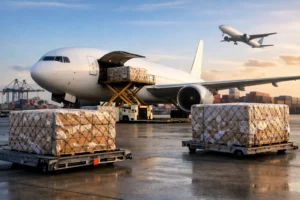
When delivery speed is critical, air freight is often the most effective option. It is commonly used for urgent commercial shipments, replacement parts, electronics, medical-related cargo, high-value goods, and products with short selling windows.
The main advantage is transit time. Air freight moves cargo much faster than ocean shipping and offers better scheduling predictability for many trade lanes. That speed can reduce inventory pressure, support faster order fulfillment, and help businesses respond to market demand without holding excessive stock.
The trade-off is cost. Air freight is usually more expensive than sea cargo, especially for heavy or bulky shipments. It also comes with dimensional weight considerations, which can significantly affect pricing. For companies shipping by air, the service works best when the value of speed outweighs the higher freight cost.
This is where strong coordination matters. Flight capacity, handling timelines, cut-off times, and customs clearance all influence whether the shipment actually moves as planned.
Sea freight is the best fit for larger and less urgent cargo
For larger shipments, sea freight remains one of the best ways to ship internationally from a cost-efficiency standpoint. It is widely used for bulk cargo, palletized goods, retail stock, industrial materials, and recurring B2B shipments where lead times are planned in advance.
Sea freight typically offers the lowest cost per unit for high-volume cargo. It gives businesses room to move larger quantities at more controlled freight rates, which is especially useful for restocking, production planning, and long-range procurement cycles.
However, lower cost comes with longer transit times and less flexibility. Port congestion, vessel schedule changes, and customs delays can affect arrival dates. For that reason, sea freight suits businesses that can forecast demand accurately and build sufficient lead time into their supply chain.
Shippers also need to choose between full container load and less than container load options. Full container load is often better for larger shipments, better cargo control, and lower handling risk. Less than container load can work well for smaller volumes, though it may involve more consolidation points and longer handling timelines.
Express courier services work well for small urgent shipments
Express shipment services are often the right choice for documents, samples, small parcels, urgent replacement items, and lightweight commercial orders. For businesses that need fast delivery with simple booking and strong tracking visibility, express can be highly effective.
This option is especially useful when shipment size is small enough that formal freight arrangements would be excessive. It is also common for product samples, contract documents, e-commerce orders, and urgent customer commitments where delivery speed directly affects sales or service quality.
The limitation is scale. Express services become expensive quickly as weight and size increase. They are rarely the most cost-effective solution for larger commercial cargo. There can also be shipment restrictions depending on commodity type, battery content, product classification, or destination rules.
For smaller urgent movements, though, express shipping provides clarity and convenience. It is often the fastest path from pickup to final delivery.
Multimodal planning is often the smartest commercial decision
Some of the best ways to ship internationally do not rely on a single mode. Many businesses benefit from a mixed shipping strategy that combines air, sea, and express services based on product category and urgency.
For example, a company may move core inventory by sea to control costs while using air freight to cover urgent stock gaps. Another business may use express services for samples and onboarding orders, then shift to sea or air once volumes increase. This type of planning creates flexibility without forcing every shipment into the same cost structure.
A multimodal model also reduces risk. If supply chain disruption affects one route or mode, an alternative shipping option may already be built into the operating plan. For growing businesses, that flexibility can make international shipping more stable and easier to scale.
Customs and documentation can make or break shipment performance
Even the right freight mode can fail if customs preparation is weak. Commercial invoices, packing lists, product descriptions, declared values, tariff classifications, and import permits all affect how smoothly cargo moves across borders.
Many delays blamed on transport are actually documentation issues. Incomplete paperwork, inaccurate declarations, or non-compliant packaging can trigger inspections, holds, penalties, or rework at origin and destination. That creates added cost and disrupts delivery commitments.
This is why experienced freight coordination matters as much as mode selection. Businesses shipping internationally need a process that covers booking, documentation review, customs handling, and milestone visibility from pickup through delivery. A premium logistics partner should help reduce friction, not simply move boxes.
How to choose the best ways to ship internationally for your business
Start with the commercial objective. If your shipment supports an urgent deadline, protects production uptime, or carries high customer impact, speed and control should take priority. In those cases, air freight or express shipment is often justified.
If the objective is cost control for repeat inventory movements, sea freight usually offers the better long-term structure. It allows better freight economics, especially when shipment planning is consistent and volume is sufficient.
Then look at the shipment itself. Weight, dimensions, cargo sensitivity, commodity restrictions, and packaging requirements all influence the best option. A lightweight high-value shipment may be ideal for air. A container of finished goods with a predictable replenishment cycle is usually better suited to ocean freight.
Finally, evaluate provider capability. International shipping is not only about transport availability. It is about execution quality. Businesses should look for a logistics partner that can manage multiple freight modes, maintain shipment visibility, handle cross-border requirements, and support changing commercial needs without adding complexity.
That is particularly important for companies shipping from Malaysia into regional and global markets. Coordinating air freight, sea cargo, and express services under one provider can simplify decision-making and improve responsiveness across different shipment profiles. For many businesses, that is where a provider like Cargovia adds value – not just by offering transport, but by aligning the method to the business requirement.
Cost matters, but total shipping value matters more
The lowest freight quote is not always the lowest business cost. A cheaper mode that causes stockouts, missed launches, or customs delays can cost far more than a premium shipment that arrives on time. International shipping decisions should be measured against business outcomes, not freight rates alone.
The strongest shipping strategy balances speed, cost, reliability, and operational control. Air freight delivers urgency. Sea freight supports scale and cost efficiency. Express services handle small, time-sensitive movements with speed and visibility. The best result comes from knowing when to use each one.
If your shipping model is built around business priorities rather than habit, international logistics becomes easier to manage and far more reliable when timing really counts.